
The book is based on a trademarked Rabbit Hole architecture. Eleven songs that map the journey, bringing it to life. Producers from the worlds of Christina Aguilera, Coldplay, and Taylor Swift. And a voice with a measured frequency range running from 50 Hz to 11,812 Hz. The full picture of why this season’s most unusual book release is also a record.
What struck me when I first opened The Woman Who Found Her Voice was not just the depth of the protagonist’s story — it was the unique architecture of the memoir itself. There are very few self-help books today that actually let you look down into the underlying forces of your own life. This one does, by design.
The author is Perukua — an Australian-born polyphonic vocalist, composer, and women’s teacher with thirty-five years on stages across three continents, in halls of up to twenty-one thousand, with magazine covers in seven European countries. The book is her first. The 11-song original soundtrack she releases alongside it is her tenth recorded album.
Rabbit Hole Storytelling™
Perukua has trademarked the literary device that holds the book together. She calls it Rabbit Hole Storytelling™. Each chapter descends through three layers — a present-day moment, the immediate momentum behind it, and the formative cause beneath that. By the third chapter, the reader is no longer just following her life; they have begun running their own through the same three layers.
“The reader doesn’t just see what happened. They see why it had to.”
That, in her own words, is why she trademarked the device — because the structure was the only honest way she could write the book.
The songs of the book
Eleven songs map onto the eleven narrative units of the memoir — prologue, preface, eight chapters, and epilogue. Two are exclusive to the book; the other nine are pulled from a working catalogue of roughly seventy compositions she has recorded over the years.
‘Cosmic Whales’, the chapter-one song, is one of the two exclusives. It is not a song in the streaming sense. It is a wordless extended-form vocal soundscape — a long polyphonic overtone piece, otherworldly in its effect, that listeners have described as among the most physically affecting recordings they have heard. ‘Indians of the Amazon’ — the other exclusive — is the song she performed the night a Sydney concert failed, and the press looked through her, the night that ended on a sandstone cliff above Bondi. ‘Mother Who Lost Her Love,’ the chapter-seven song, is the one that made me put the book down for a moment when I read the prologue: the appearance of Perukua’s mother is the kind of opening that sets the temperature of everything that follows. And ‘You Must Believe,’ the closing song that maps to the epilogue, reads as the entire memoir compressed into four minutes — a little girl at the bottom of the world, told by her mother she does not have the gift, told by a wise woman at seventeen that the path will be hard and she has to walk it anyway.

The people in the room
The collaborators Perukua brought into this record are the kind of names you read on liner notes from the world’s biggest artists.
Heather Holley — the multi-platinum songwriter and producer who launched Christina Aguilera’s career and has gone on to work with Skylar Grey and Jackie Evancho — produced four tracks on the album: ‘Be Yourself’ (the prologue song), ‘Mother Who Lost Her Love,’ ‘My Soul Is Guiding Me,’ and ‘You Must Believe.’ Holley has been based and working in Los Angeles for over twenty years; her 2014 LA recording session with Perukua produced ‘Be Yourself,’ the song that now opens both the book and the album.
Dave Eggar — four-time Grammy-nominated cellist and composer, Juilliard- and Harvard-trained, the cellist whose voicings you have heard on Coldplay’s ‘Viva la Vida,’ on records by Evanescence, Frank Ocean, Beyoncé, Taylor Swift, Andrea Bocelli, Amy Winehouse, and Imagine Dragons — brought string orchestrations to two of the album’s most cinematic tracks: ‘My Soul Is Guiding Me’ and ‘You Must Believe.’
Tom Wasinger — the three-time GRAMMY® Award winner who lived and worked in Los Angeles for many years before relocating to Boulder, Colorado — recorded the chapter-two song, ‘Great Mother.’
The voice itself
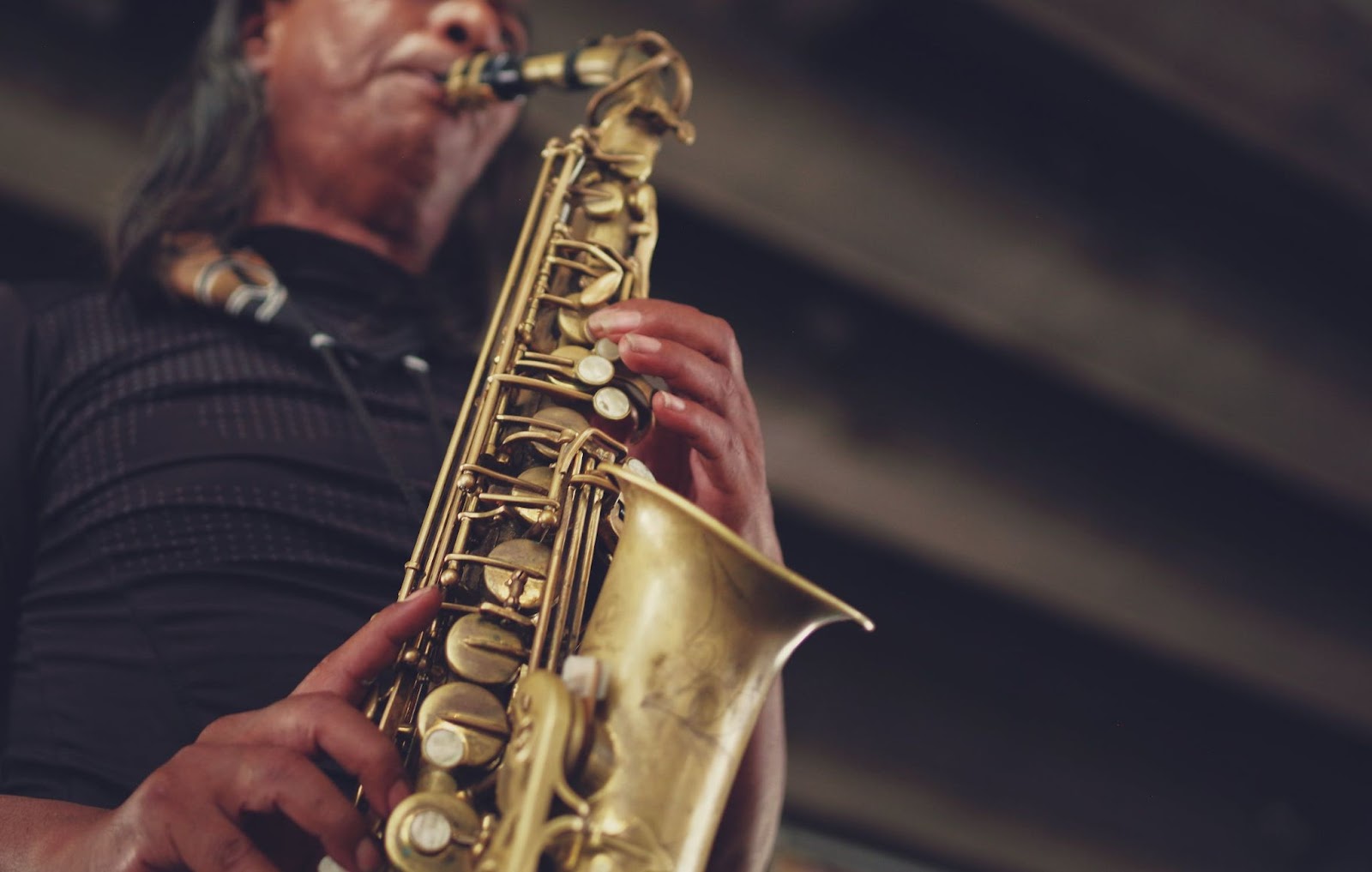
Perukua sings in polyphonic overtones — a technique in which her main tone splits into up to three simultaneous overtones above a fundamental. The combined frequency range, when measured in studio sessions, runs from 50 Hz to 11,812 Hz. That is close to the practical bandwidth of human hearing.
“A voice that goes straight to the most delicate chords of the soul.”
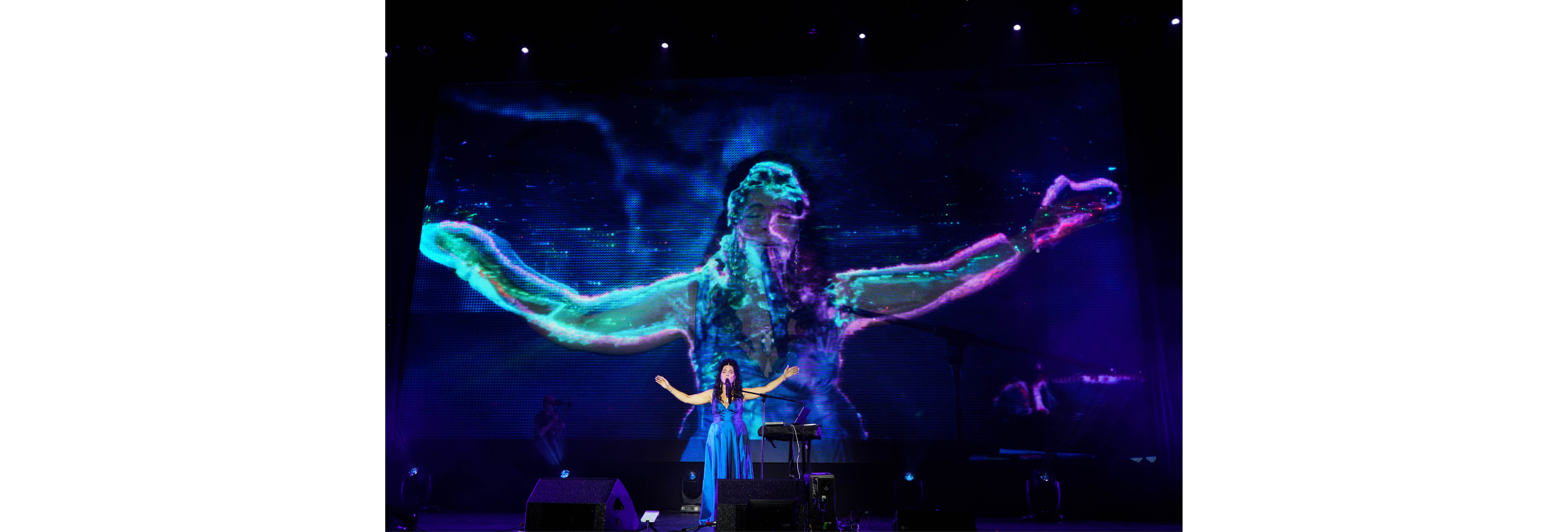
In 2017, after two decades of developing this voice in private, she performed it publicly for the first time at her own concert called Voice and Cosmos. Six thousand people were in the room. ‘The effect was profound,’ she has said since. ‘I knew that night the voice was meant to be in the world.’
Beyond the book and the album
Perukua’s practitioner work has reached more than 200,000 women across thirty-plus. Her authentic practices is what the women in her workshops have been carrying back into their daily lives for decades, and the book is, in many ways, her long answer to the question they kept asking her: how does a voice come into being?
“A voice that’s afraid of itself is the loudest silence in the room.”
The album was recorded across multiple sessions and locations, but its anchor is here. Heather Holley produced four of its eleven tracks across her two decades of LA-based work — from the 2014 session that gave the world ‘Be Yourself,’ the song that now opens both book and record, to the closing track that maps to the epilogue. Some albums travel a long way to find their producer. This one came home.
Perukua’s memoir, The Woman Who Found Her Voice, and its 11-song companion soundtrack are released this season. More on her work, the recordings, and current dates are at peruquois.com.
Written in partnership with Tom White