
When we think of a haunted house, we picture rattling chains, sudden cold drafts, and objects moving in the dark. But when we think of a haunted marriage, the signs are far more mundane. The ghost doesn’t throw dishes; it sits quietly at the dinner table. It lives in the carefully avoided topics of conversation, the polite distance maintained while folding laundry, and the heavy, exhausted silence of two people who have stopped asking each other the hard questions.
We bring our pasts—our unmet needs, our unhealed wounds, and our secret “what-ifs”—into our long-term relationships. And if left unaddressed, these psychological phantoms will eventually demand to be seen.
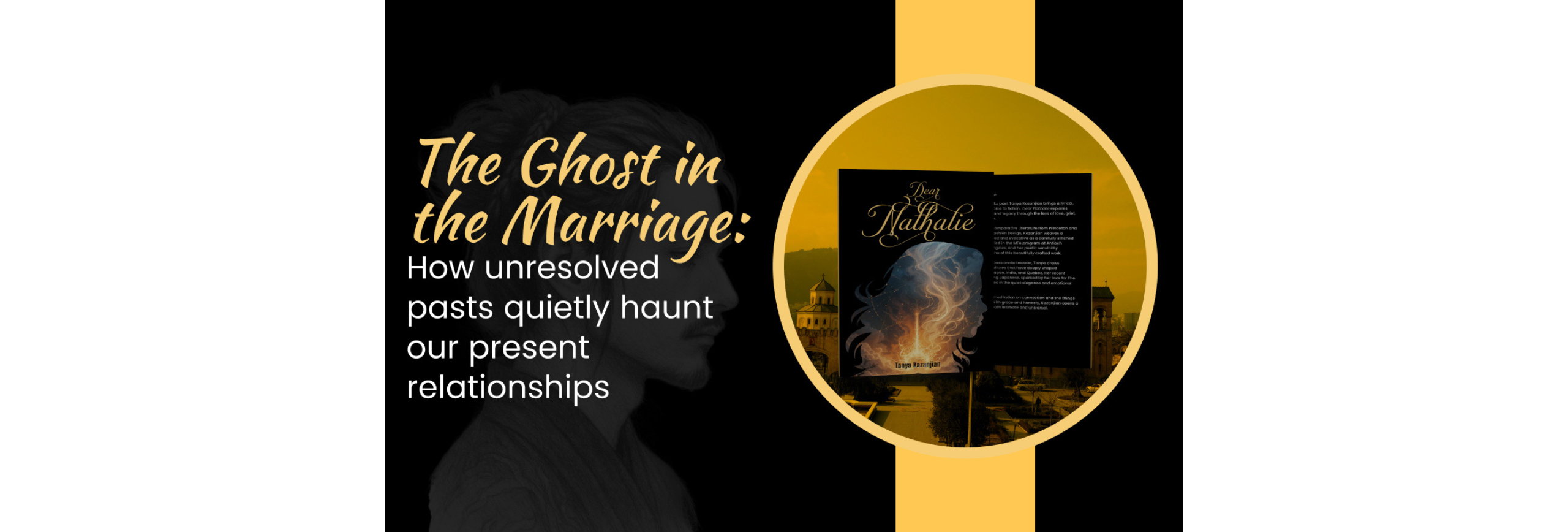
This chillingly universal dynamic is masterfully explored in Tanya Kazanjian’s literary novella, Dear Nathalie. While much of the book delves into the mystical bond between Gregory and a deeply spiritual woman named Nathalie, the true tragedy of the story takes place inside the walls of Gregory’s own home. Through the incredibly raw journal entries of his partner, Suzanne, Kazanjian delivers a devastating autopsy of a dying relationship.
It is a story that asks a terrifying question for anyone in a long-term partnership: Are you and your spouse actually building a life together, or are you just comfortably haunting the same house?
The Illusion of “Disaster-Proofing” Love
For sixteen years, Gregory and Suzanne live in a state of perfectly curated avoidance. They share a home, they raise two children, and they navigate the logistics of daily life with the practiced ease of roommates. What they do not share is depth.
For Gregory, who is deeply terrified of change and failure, this arrangement is not a problem; it is a strategy. He operates under the belief that by avoiding the legal and emotional finality of marriage, he is somehow protecting himself from the pain of divorce. If you never sign the contract, you can never technically break it.
Suzanne complies with this. She swallows her early disappointment over the lack of a proposal, convincing herself that their easy, frictionless companionship is enough. “The fact is, we were happy, and the absence of a ring or a wedding ceremony didn’t really matter when measured against the richness of our daily life,” she writes.
But Kazanjian exposes the fatal flaw in this thinking: the absence of conflict is not the presence of intimacy. Gregory and Suzanne’s relationship is built on a foundation of avoidance. They trim the sails and adjust the course to avoid every passing storm, confusing this constant, exhausting recalibration for real stability. But underneath the floorboards, the ghost of their unmet potential is waiting.
The Haunted Heirloom
A ghost needs a conduit to enter the physical world, and in Dear Nathalie, that conduit is an antique ring.
After sixteen years of comfortable stagnation, Gregory suddenly proposes to Suzanne. It should be a moment of triumph, the culmination of a decade and a half of loyalty. But the proposal is born of a secret. The ring Gregory uses does not come from a jewelry store, carefully chosen with Suzanne in mind. It comes from Nathalie, his deeply spiritual confidante from work. Nathalie gave Gregory the heirloom, and Gregory, in a moment of emotional laziness, repurposes it for his wife.
When Suzanne discovers the true origin of the ring, the psychological blow is fatal. The ring becomes a poisoned apple—a physical manifestation of the invisible woman who holds the emotional depth Gregory has withheld from his own family.
“It makes me feel both humiliated and disposable, as though even this defining moment of our lives was borrowed, secondhand, without thought or originality,” Suzanne writes.
In real life, the ghosts in our marriages rarely take the form of an antique ring from a twin flame. But the metaphor holds true. We hand our partners our second-hand efforts. We give them the exhausted, leftover versions of ourselves, while pouring our passion, curiosity, and vitality into our careers, our friendships, or our private fantasies.
Emotional Infidelity and the Threat of Depth
If Gregory had been having a physical affair with Nathalie, Suzanne’s reaction might have been simpler. Physical infidelity is a tangible betrayal. It comes with a script. You get angry, you go to therapy, you divorce, or you rebuild.
But what Gregory is doing is far more insidious. He is engaging in a profound emotional and spiritual infidelity. When Suzanne finally reads the years of emails exchanged between her husband and Nathalie, she expects to find seductive lines and declarations of forbidden love. Instead, she finds something much more dangerous: absolute, unvarnished vulnerability.
Nathalie writes to Gregory about her traumas, her poetry, her spiritual crises, and her overwhelming loneliness. And Gregory—who spends his home life avoiding any conversation that cuts too close to the bone—listens. He becomes her caretaker, her sounding board, her anchor.
As Suzanne reads the letters, the ghost steps fully out of the shadows. “She plants questions in him, seeds that begin to sprout in the private corners of his mind, making him wonder, making him reflect on things he had long ignored or dismissed,” Suzanne realizes. “Shouldn’t it have been me who prompted those questions, me who inspired that reflection, me who nudged him toward growth?”
This is the most terrifying realization a person can have in a long-term relationship. It is the realization that your partner is capable of incredible depth, empathy, and spiritual connection—they just don’t want to share it with you.
“Lipstick on a Pig”
Once a ghost makes itself known, you can never unsee it. The illusion of Gregory and Suzanne’s safe, predictable life shatters, leaving Suzanne to grapple with the painful truth of what she has accepted for sixteen years.
She looks at her relationship and realizes it has been an exercise in performative contentment. “It feels as if we’ve been painting over cracks, dressing up a life that maybe never was as perfect as I pretended,” she admits in her journal. “Lipstick on a pig—that ugly phrase keeps running through my mind, because it feels true. We kept covering and covering, smiling for the children… while deep down I carried disappointment, and he carried fear.”
This requires immense bravery to admit. It is incredibly difficult to walk away from a relationship when nothing is violently wrong. Society gives us permission to leave a partner who is cruel, abusive, or unfaithful. But it is much harder to explain that you are tearing your family apart simply because neither of you is growing.
Suzanne realizes that remaining in the marriage means shrinking herself to fit a narrow, oxygen-starved role. The ghost of Nathalie didn’t ruin Suzanne’s marriage; Nathalie simply held up a mirror to a union that had been dead for years.
Facing the Phantoms
Kazanjian’s Dear Nathalie is a masterful, haunting piece of literature because it refuses to let its characters—or its readers—off the hook. It demands that we look at the quiet corners of our own lives.
What conversations are you avoiding with your partner because it is easier to keep the peace? What parts of your soul have you locked away because you fear they are too heavy for your spouse to carry? Who are you outside of the logistical machinery of your household?
If we do not ask ourselves these questions, we run the risk of becoming ghosts in our own lives. We end up like Gregory and Suzanne, passing each other in the hallway of a shared house, filled with resentment, haunted by the people we could have been if only we had been brave enough to demand the truth.
Love, in its truest form, is not about disaster-proofing your life. It is about taking the risk of being seen, in all your messy, unresolved glory. And it is about ensuring that the only spirits residing in your home are the ones you invite in together.
Media Details:
Amazon: DEAR NATHALIE
Author: Tanya Kazanjian
Website: www.tanyakazanjian.com
Written in partnership with Tom White