
Image Credits: Unsplash
Reliability and privacy are two concerns for data analysis professionals. They are turning to AI for assistance.
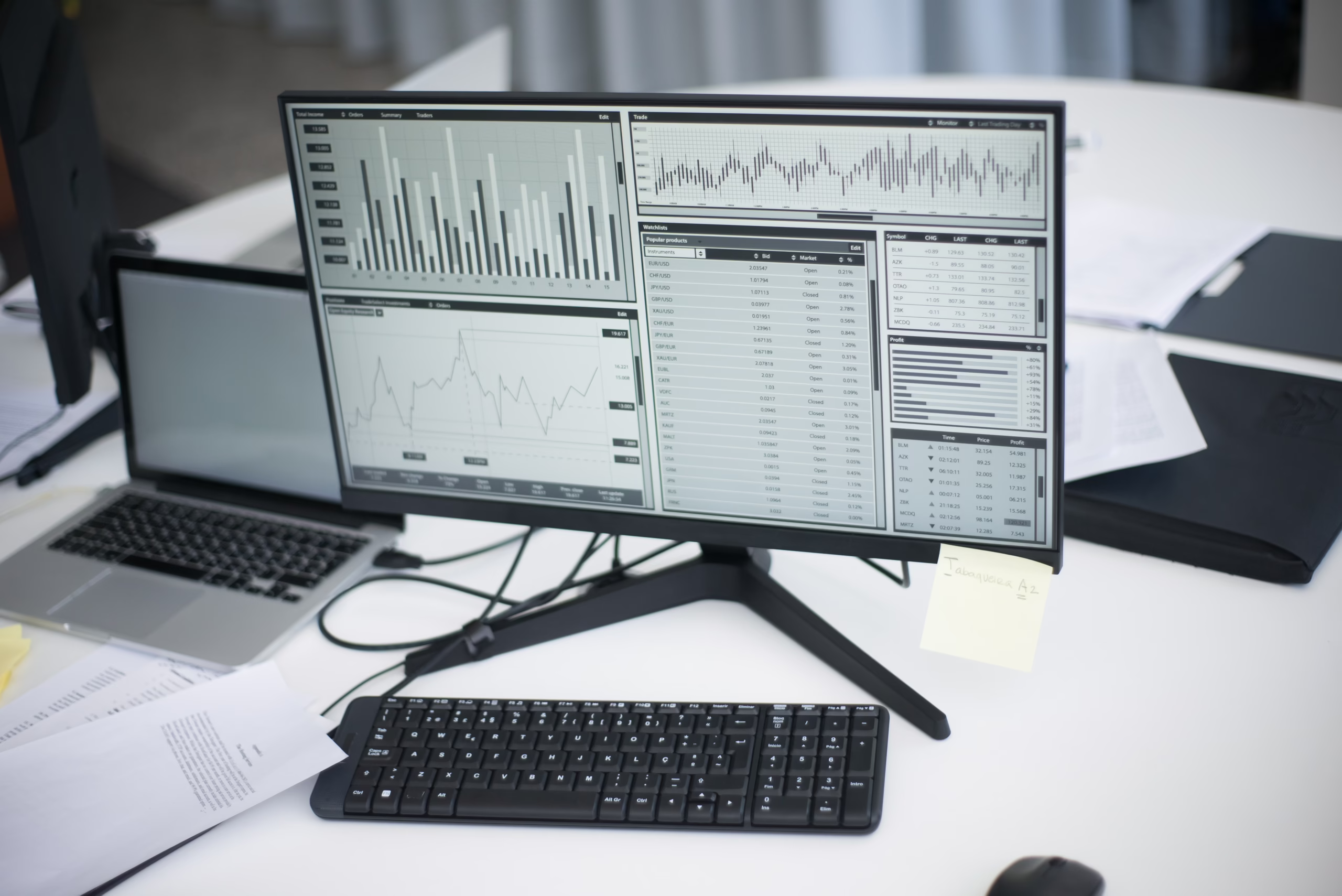
AI is helping professionals centralize data from across dozens of sources. CRMs, ERPs, cloud platforms, and others funnel data to professionals, necessitating sorting through large volumes of varied information.
The challenge is not just collecting data; it is trusting it. Artificial intelligence is emerging as the throughline, helping businesses aggregate data and separate what is reliable information.
From eliminating redundant processes to establishing private, curated workspaces, AI has the capacity to reshape how businesses transform pools of data into actionable insight.
Improving Data Synthesization
Artificial intelligence has demonstrated the ability to process and catalog vast amounts of information. That is not what makes AI transformative in data solutions. David Marco, PhD, the President & Executive Advisor of EWSolutions, advises C-suite leaders on building robust data governance frameworks, which provide AI with reliable material to work with.
Marco’s firm has documented environments where data is 7 to 10 times more redundant than necessary. Approximately 80% of business analytics lies dormant in these spaces.
He explains, “… AI tells us what deserves to be trusted; because it is not about how much data we have, it is about what we can trust.”
The prized skill of AI is bringing clarity to the data.
Automatic manual data cleanup can be performed by AI, replacing tens of thousands of hours of human work with a few weeks of effort. It can identify and eliminate redundant data flows and dormant analytics.
The consequences, Marco expands, can be costly. He claims, “And every redundant data flow is a tax on your business.”
Numerous data redundancies create a major risk for companies. A case study claimed that 700% unmanaged PII replication on PCs had a significant possibility of causing businesses problems in the future.
Further, AI adoption is a competitive initiative.
Marco informs, “AI makes decisions at the speed of business, at the speed of light, and it can be millions in a day. You do not get a month to go back and fix it.”
He continues, “It needs to be right the first time. And that is why we need great data and a great decision integrity process.”
Increasing Privacy in Workspaces
AI may assist companies with redundancy issues, but others use the tool to address a separate issue. Analyzing sensitive information is a requirement of businesses, but public AI tools lack the security.
Paul Maguire is the CEO of Medullar, a platform designed to address privacy gaps consultants and professionals encounter when using consumer AI for their strategic work.
Medullar helps synthesize and protect, which Maguire explains as, “Instead of throwing the information in the ocean, you get a cup. This is the Medulla Space; there are only things relevant to your search in here, nothing else.”
Medullar creates a “Medulla Space”, a curated “cup” from an “ocean” of data which connects over 70 data sources, including SharePoint and Gartner research.
Maguire clarifies, “We built Medulla by and for people that are working in sensitive and private information, sometimes even confidential information.”
He says, “The public LLMs are out; if you are going to throw caution to the wind and put up a business plan in ChatGPT, if you are a lawyer, you are going to get disbarred for disclosing confidential information.”
The data is then filtered into a private space where a Microsoft-hosted AI analyzes it without exposure to external models. A vector database further assists by surfacing non-obvious patterns and correlations that human analysis may miss.
Maguire adds, “A vector database takes everything, all the words, sentences, and paragraphs, and converts them into vectors, into numbers.”
He continues, “When you ask a question, it finds that three out of the five companies you interviewed share the same architecture…That is where you get insights.”
Challenges Persist, Solutions Develop
Data volumes continue to grow, and enterprises that expand may be those that use AI as a data governance partner rather than a simple productivity tool. From eliminating redundancies to securing sensitive information, AI has become a key differentiator between companies that use reliable data and those that don’t.
Centralization will continue to challenge professionals, but the tools available are becoming more intelligent.