
Image credit: Pexels
From brainstorming and prototyping to education and storytelling, emerging AI workflows point toward collaboration, not substitution, as the more practical model for creative work.
The debate over generative AI has always centered on whether machines will replace creative professionals. Concerns about displacement, ownership, sameness, and overreliance are understandable. However, design, entertainment, education, music, marketing, and communication raise a more practical question: which parts of creative work can AI improve while people retain creative direction?
This shift points toward a human-in-the-loop model, in which AI accelerates creative processes without becoming the creative authority.
Breaking the Blank-Page Problem
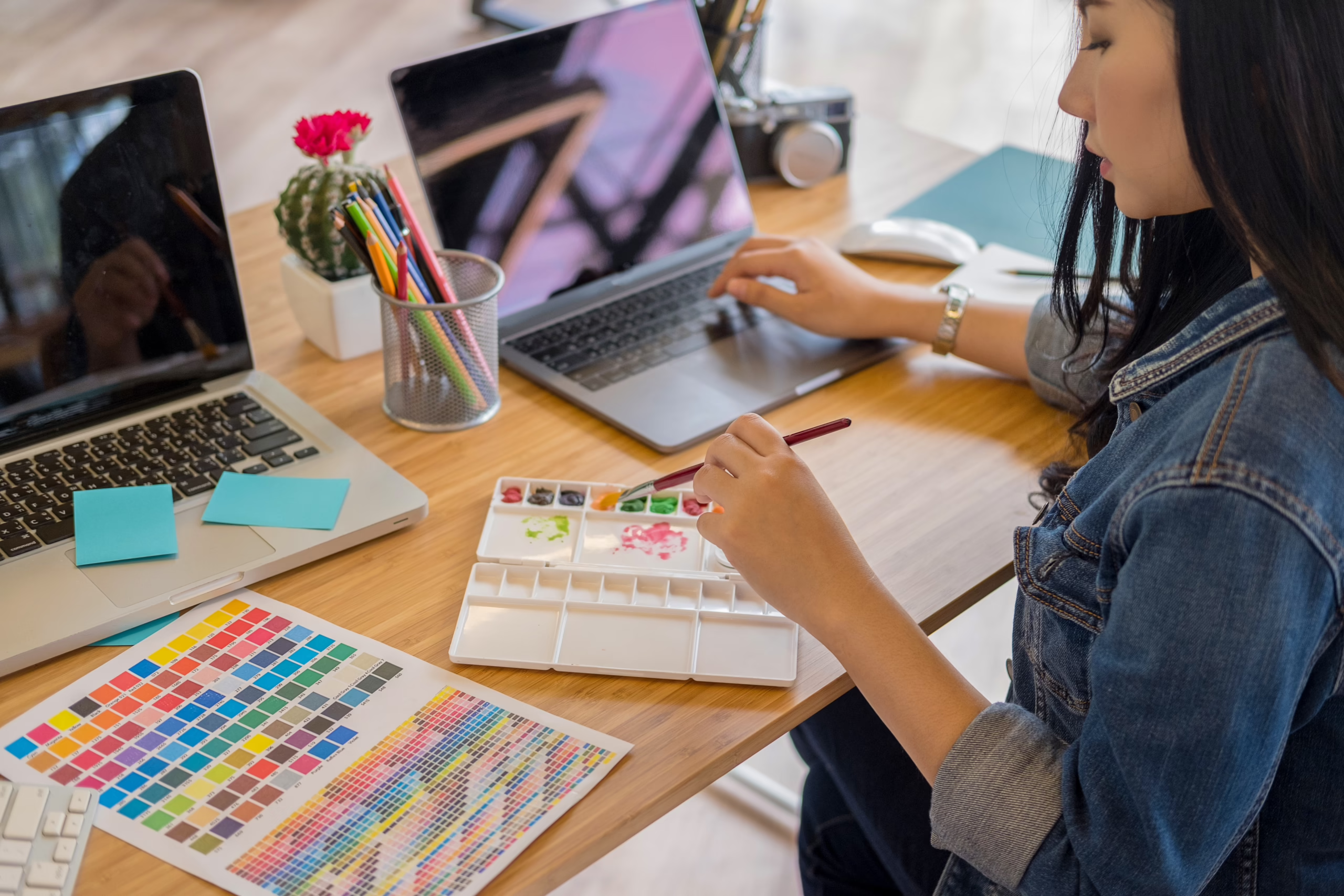
Creative block offers one of the clearest examples. AI can quickly generate alternative concepts, headlines, visual directions, campaign ideas, and counter-arguments. The first response does not need to be the final answer; it can simply provide momentum.
Navonaya Brahmachari describes the value of that process through ideation and campaign development.
“The 10 different ideas may not be exactly what you want to do, but they at least give you a head start.” Instead of staring at a blank page, creators can edit, question, and refine possibilities. “So you do not just get stuck anymore,” she says. The principle remains human-led as she explains: “We have a famous saying, you know, human in the loop, so that can never go.”
The same approach can remove low-value work. Formatting, resizing, proofreading, organizing, research, and brand compliance can consume substantial creative time, particularly in large organizations. Brahmachari’s discussion of SAP‘s Joule illustrates how automating brand-compliant presentation work can leave storytelling at the center.
At Memoket, AI can help build mockups and refine language, while people retain responsibility for concepts and voice.
Elisa Lo explains, “We’re definitely using AI as our thought companion,” while stressing that “AI still needs us to be the thinker, the original thought starter.” Ultimately, “We human beings are still the center of everything we do and want to embrace and want to protect that humanity.”
Edo Campos similarly says, “We do not let AI write the copy for us.” Instead, “The main idea, the core sense of the copy, the voice comes from the humans.” He adds, “It really opens and smooths the workflow on the design part.”
Making Experimentation More Affordable
Creativity is also constrained by economics. Film concepts, advertising campaigns, and product ideas can remain unrealized because polished proof-of-concept costs too much. AI can make experimentation faster and cheaper.
Dion Johnson of IndieMe.ai sees AI as a starting point: “I view AI as the starting point. It is not the end point.” He argues that “AI is being considered as a tool, allowing this creativity to blossom.” “Those who understand it and can use it as a tool, not as a replacement, will be able to create beautiful things that can change the world.”
This opportunity comes with protection concerns. IndieMe.ai monitors potential misuse of artists’ likenesses and creative work to illustrate the safeguards developing alongside AI capabilities.
What Machines Cannot Reproduce?
Efficiency, however, does not answer the question of what makes creative work emotionally meaningful. AI can identify patterns and imitate forms, but it does not possess childhood memories, relationships, grief, embarrassment, physical sensations, or cultural belonging.
Johnson argues that actors develop characters through lived or researched experience and that audiences respond to subtle emotional cues.
“AI can’t do that. It does not understand the emotional context that’s associated with doing a specific task.” As he puts it, “It’s not about the pain. It’s about the process.” Ultimately, “The story of your life is something that’s intricate to you.”
Building the Skills Behind Creativity
AI can also help people develop the fundamentals needed for creative expression. Sergey Kuhne’s Singing Carrots uses AI to personalize vocal exercises according to individual voices and skill levels. “Our tool is like unlocking creativity in people.”
Kuhne explains, “We first teach them how to, like, deal with the primitives. So then once, like, they learn how to do that, they can get into the more advanced thing and, like, be creative in the thing that they’re learning.”
Setting an example, he added: “You kind of have singing teachers who are supercharging their intelligence by augmenting themselves with the AIs like ours.”
Knowing When Humans Must Take Over
The human-in-the-loop principle extends into education. At the University of the People, AI can handle repetitive questions and administrative tasks, allowing educators to focus on discussion and personal attention.
Shai Reshef says, “AI will help us, help the students to study much better and the professor teach much better.” Highlighting the professors’ role, Reshef said: “The main role of professors in our case and in all universities going forward will be to be the moderator of discussion and to give personalized attention to the students.”
AI can also identify students at risk of dropping out, but meaningful intervention may still require a person to call and help a student put a temporary setback into perspective.
Reshef therefore warns, “You must be very thoughtful about how you use AI, for what you’re using AI.”
This principle applies equally to creative work. AI literacy means evaluating outputs, questioning assumptions, verifying sources, and knowing when not to delegate.
“We teach our students to try to evaluate whether it does good or bad. And to stop when it does bad.” Otherwise, “Sometimes it’s tempting to use AI instead of thinking.”
Keeping Creativity Human
Across design, marketing, entertainment, music and education, AI is generating options, handling mechanics, building prototypes, personalizing practice and identifying patterns. Humans continue to provide purpose, taste, voice, emotional context and final judgment.
The future of creative AI may therefore depend less on how much automation people accept than on which responsibilities they choose to retain. Used deliberately, AI can function as creative infrastructure, broadening experimentation and removing mechanical work while preserving authorship, ownership, ethics and human judgment.